An Amazing River Runs Through East Central Indiana
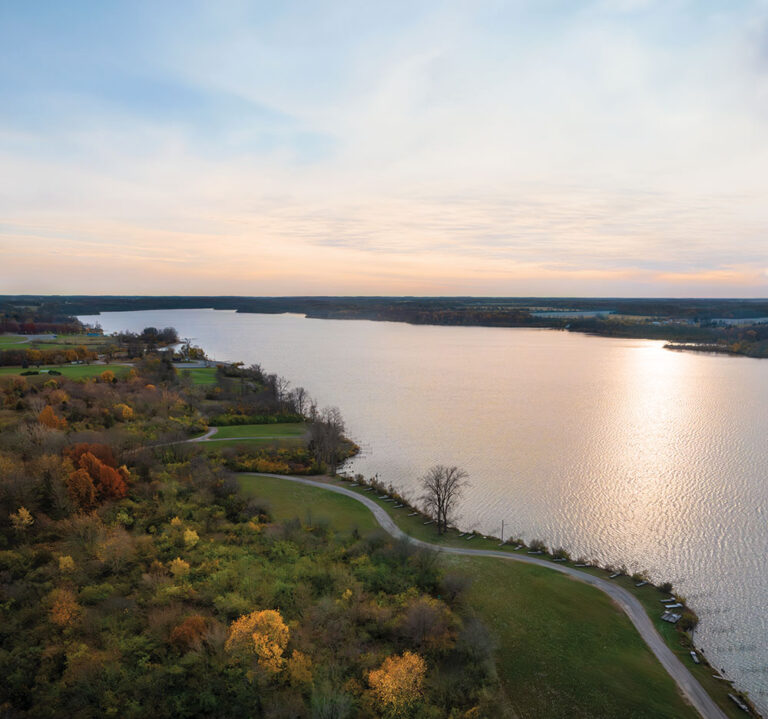
Rick Conrad has no qualms with rainforests, savannahs or coral reefs. But Conrad, director of the Muncie Sanitary District’s Bureau of Water Quality, knows that minutes from home, East Central Indiana residents can find an equally impressive ecosystem teeming with diverse plant and animal life – the White River.
“There are over 60 species of fish in the river, some with colors that would rival many tropical species, but you would never know they were there if your only connection is a hook and line,” Conrad says. “The freshwater mussels have such a unique life history; you could make an hourlong documentary film on them alone, but if you just walk across the river, you might never notice they were beneath your feet.”
Helming History
Muncie-based groups are working to protect these natural resources and welcome visitors to explore the White River through ongoing restoration projects and tourism initiatives. These include adding five launches for canoes, kayaks and inner tubes in Muncie so people can better explore the river.
The Ball Brothers Foundation is sponsoring many improvements through Project Blueways. This initiative aims to elevate the White River and Mississinewa River to the same status as popular local greenways. Foundation Vice President Jenna Wachtmann sees it as a natural extension of the Ball family’s river preservation efforts dating back to the 1920s.
“People don’t love what they don’t know. We’re looking for ways for kids, families and their friends to connect with the water and with the land,” Wachtmann says.
Additional efforts include removing dams and constructing a new Mussel Propagation and Education Center. Endangered freshwater mussels clean the water, and their presence indicates high water quality, so the center will be a valuable resource for research and education.
“The White River in this area has the healthiest aquatic life on the 400-mile stretch of the White River, including one of the largest and most diverse mussel populations in the state.”
Rick Conrad, Muncie Sanitary District’s Bureau of Water Quality
However, there is still much work to do, according to David Heilman, landscape architect at FlatLand Resources, a Muncie-based design-build consultant firm engaged in the restoration projects. “And it has not been easy getting to this point,” he says.
First, settlers began reconfiguring the land and waterways to make the Midwest amenable to agriculture, which contributed to erosion. Then industrial sites and municipal sewage systems dumped pollutants into the river. This was no accident, but an advertised approach to waste management.
To combat rampant pollution and bacteria in the river, Muncie built its first water treatment plant in the 1940s. The city’s efforts predated the Clean Water Act of 1972 and the creation of the Environmental Protection Agency.
“Through the tireless work of a local advocate, John Craddock, and the Bureau of Water Quality, Muncie was a leader in the Midwest – and the nation – at curbing industrial discharge into the river and implementing water quality improvement initiatives,” Wachtmann says.

Education, Careers & Opportunity
East Central Indiana: Feeding the Nation
The region produces everything from top-quality lunch meats to delectable baked goods.
Flowing Forward
Today, Muncie’s Water Pollution Control Facility treats over 6 billion gallons of wastewater annually before returning it to the White River, according to Conrad. The Bureau of Water Quality tests and enforces regulations against pollution by local industries.
Still, contaminants from roadways, construction sites, lawns and agricultural sites, along with sanitation infrastructure that can be overwhelmed by heavy rains, can flow into the river.
“We often take clean water for granted,” Conrad says. “It’s easy to forget how the White River affects our lives both directly and indirectly.”
Heilman believes the biggest challenge is patience. Correcting decades of harmful policies and norms is possible but doesn’t happen overnight. Getting people invested in the White River through new recreation and education opportunities is an important first step.
“I’d like to believe that I’m leaving our corner of the world a slightly better place for future generations,” Heilman says. “I am fortunate that there have been hundreds of people who have worked tirelessly over the years to make Muncie and the White River a better place to live, work and play.”

Venture Along the White River Greenway
The White River Greenway, a more than 5-mile paved trail in Muncie, runs alongside parts of the White River, offering beautiful views and access to attractions along the way.
It’s common for walkers, joggers and bicyclists to see herons, swans and cranes while on the path, but the greenway also connects to three parks and a museum.
One example is Westside Park, which has large, mature trees and attractions like a little league/ softball diamond, basketball courts, a playground, a shuffleboard court and shoreline fishing along the White River.
Adjacent to the greenway is Tuhey Park, which features a pool, a splash pad, picnic tables and a picnic shelter. Tuhey Park is near the greenway’s midpoint, and the park includes new playground equipment known as Tuhey Towers.
McCulloch Park has been an outdoor staple in Muncie since the early 1900s, and the greenway runs along its southern boundary. McCulloch has a sledding hill, two playgrounds, a disc golf course, basketball courts, a baseball diamond and a Soap Box Derby track. The park even served as a spring training home for the Pittsburgh Pirates from 1943 to 1945.
Another highlight of the greenway is Minnetrista Museum & Gardens, which has exhibits, nature trails, educational programs and community events. A main attraction for visitors is an exhibit called the “Bob Ross Experience,” showcasing “The Joy of Painting” studio that famed artist Bob Ross used during his professional TV show painting days in Muncie from 1983 to 1994.
When venturing along the greenway, people can stop and relax on one of the numerous available benches and enjoy the view. This trail is the perfect place to go for a jog, bike ride or walk with family or friends.
– Kevin Litwin contributed to this article.
Get to Know East Central Indiana
Want to learn more about living and working in East Central Indiana? Check out the latest edition of Livability East Central Indiana.